International sleep expert consortium meets at Exeter
Leading sleep scientists from around the globe came together at Exeter College in late June to establish the first international standard for rodent sleep research. The week-long consensus meeting marked the final milestone of a project involving 56 experts in preclinical sleep science, initiated and led by Exeter’s Staines Medical Research Fellow, Dr Lukas Krone. Supported by the European Sleep Research Society and endorsed by sleep research organisations worldwide, the project aims to align research practices used to gain fundamental insights into the regulation and functions of sleep, making research more efficient and findings more comparable across laboratories.
Exeter’s Cohen Quad provided an ideal setting for the meeting. Its new AV system, optimised for hybrid sessions in the Fitzhugh Auditorium, together with several well-equipped seminar rooms, allowed participants to move between plenary discussions and smaller working-group sessions throughout the week.
The week concluded with Oxford’s first Sleep Science and Medicine Day, which attracted more than 150 participants for presentations, poster sessions and a panel discussion. The programme culminated in a joint keynote lecture by Dr Christelle Peyron (Lyon, France) and Professor Thomas Kilduff (Stanford, US), who received the prestigious SCNi Medal for their seminal contributions to the discovery of the neurobiological basis of narcolepsy.
Reflecting on the event, Dr Krone said:
“Curiosity-driven basic research is the cornerstone of innovation in medicine. Our awardees mapped a wake-promoting neurotransmitter system in rats, which is now the pharmacological target for two recently approved classes of medication that can either promote sleep in patients with insomnia or stabilise wakefulness and prevent debilitating sleep attacks in patients with narcolepsy.”
Speaking about Exeter’s longstanding commitment to basic research in physiology and medicine, he added:
“There are very few funding schemes that provide clinicians with the freedom to focus on fundamental discovery research. The Staines Medical Research Fellowship has supported scientists committed to bridging the gap between basic science and clinical practice for almost a century, starting with Sir John Eccles, who went on to win the Nobel Prize in Physiology or Medicine. I am very grateful that Exeter continues to acknowledge and support clinicians who aim not only to treat the patients of today but to cure the patients of tomorrow.”
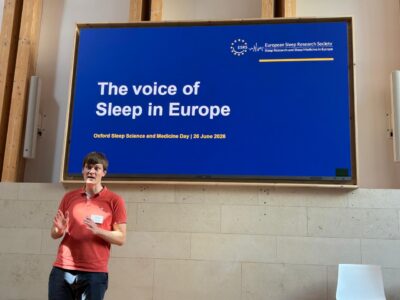
Dr Lukas Krone presenting on “The voice of Sleep in Europe” at Oxford Sleep Science and Medicine Day 2026.
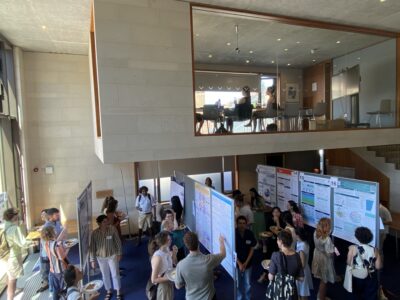
Researchers and attendees exchange ideas during the poster session at Oxford Sleep Science and Medicine Day 2026 in Cohen Quad.