As part of Exeter’s commitment to improving the sustainability of the College, it is actively seeking to reduce its waste generation and, where necessary, shift a greater proportion of its waste to more sustainable recycling and anaerobic digestion.
Exeter partners with SELECT Environmental Services to measure, remove, and process its waste such that none of it goes to a landfill. Refuse is instead sorted into three categories:
- Food waste is processed by anaerobic digestion, in which microorganisms break down biodegradable material, producing both energy and useful compost.
- Glass and dry mixed recycling items are sent to a Materials Recovery Facility where they are separated into individual material streams such as paper, cardboard, plastics, and metals, for reprocessing.
- All other general waste is sent to an energy-from-waste plant, where it is burned to produce electricity.
All college facilities, including student accommodation, include clearly labelled recycling bins and sealed food waste containers are in every kitchen. The College monitors waste production across all of its sites, both to detect anomalies and promote improvement.
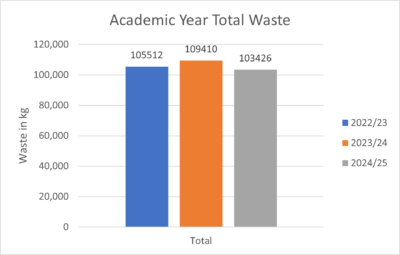
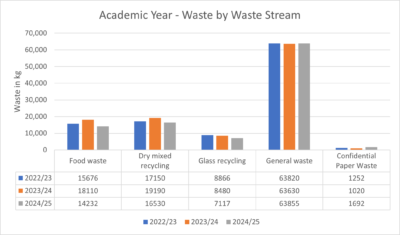
As visible in the Academic Year Total Waste graph, in 2024/25, SELECT collected 103 tonnes of waste from Exeter College, which was a 5.5% decrease from 2023/24.
More than 40% of the College’s waste is directed towards more sustainable categories: in the 2024-25 academic year, 24% of waste was recycled and 14% was sent to anaerobic digestion. The remaining 62% of General Waste was recovered as Energy-from-waste.
Still, there is much room for improvement: Exeter is committed to reducing the overall tonnage and increasing its share of composting and recycling.
To read more about the College’s progress in waste management read the 2024-2025 Annual Sustainability Report.