Exeter College DPhil student wins international prize for cardiac research
Dr Ben Bussmann, a DPhil student at Exeter College, was awarded the Geoff Burnstock Prize for Best Oral Presentation in the clinical science category at the recent International Society of Autonomic Neuroscience (ISAN 2026) meeting in Bologna, Italy for his presentation entitled “Precision ultra-hypofractionated radiotherapy to the stellate ganglia for ventricular arrhythmia (the first-in-man RADIO-STAR trial)”.
RADIO-STAR is a British Heart Foundation funded phase 1 clinical trial (ISRCTN 49861434, REC/SC/0005) involving a collaboration between clinical oncologists (Dr Ami Sabharwal), neuroradiologists (Dr Fintan Sheerin) and cardiologists led by Prof Neil Herring (Chief Investigator), Tutor in Medical Science and Fellow at Exeter College . Ben is a British Heart Foundation Clinical Research Training Fellow undertaking a DPhil in the Herring group.
Life threatening heart rhythms are often triggered by groups of nerves that speed up the heart. Surgically removing these nerves is a promising treatment in patients with weak hearts, but the risk of complications is high. Magnetic resonance (MR) imaging-guided radiotherapy has improved the precision and accuracy of radiation treatment for cancer. Adapting this new technology also offers the ability to precisely target and modify the nerves going to the heart in a stepwise manner without the risk of complications associated with surgery. The Oxford team have developed novel MRI and radiotherapy protocols to clearly visualise and accurately target the stellate ganglia. To-date 9 patients have completed radiotherapy treatment. Preliminary findings indicate that image guided radiotherapy to the stellate ganglia is feasible and safe demonstrating a reduction in arrhythmia burden although completion of patient recruitment is required to evaluate efficacy. A methods paper outlining the trial has recently been published in BMJ Open, available here.
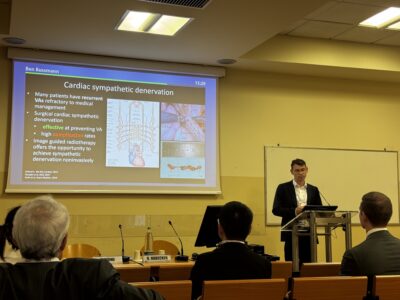
Dr Ben Bussmann presents his award-winning research on cardiac sympathetic denervation at the ISAN 2026 meeting in Bologna, showing a slide about using image-guided radiotherapy to target cardiac nerves as a potential treatment for ventricular arrhythmias.